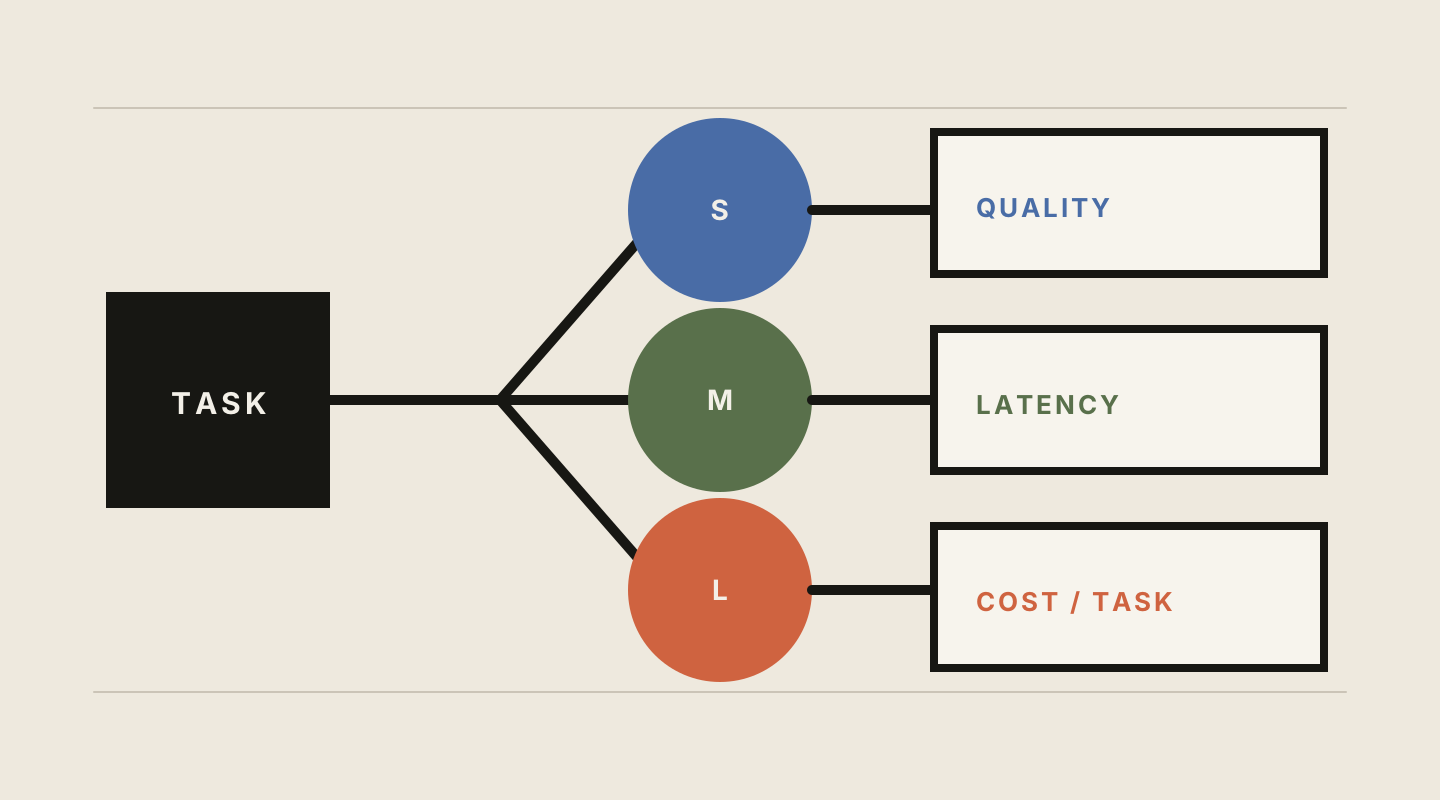
A lower model price can make an architecture look cheaper on paper without reducing the cost of the workflow. Failed outputs, retries, longer review, and escalation to another model all create costs that a token price does not show.
Separate the decision from the headline
OpenAI announced an 80% price cut for GPT-5.6 Luna and a 20% cut for Terra, while pricing Sol Fast mode at twice Standard for up to 2.5 times the speed. Anthropic introduced Claude Opus 5 as a near-frontier option at roughly half the cost of Claude Fable 5.
Both announcements show how quickly model economics can move. Neither proves which model is cheaper for a specific process, because call volume, context length, retry rate, review time, and output quality still vary.
A practical evaluation frame
A routing table should record at least:
- the task and its minimum quality threshold;
- latency from accepted input to usable output;
- total tokens, retries, and human review;
- the share of tasks escalated to a stronger model;
- the consequence of an incomplete or incorrect result.
A smaller model may be enough for classification or format conversion. A step involving difficult judgment, long context, or expensive errors may need another tier. Good routing allocates quality deliberately instead of forcing every step toward the lowest list price.
What the evidence does not prove
The cited benchmarks come from the model publishers. They are useful shortlist inputs, but they do not replace a blind test on the real data, prompts, tools, and acceptance criteria of the workflow.
Action this week
Select 20 representative tasks, run two models blindly against the same inputs and rubric, then calculate cost per accepted output. Change the default only after quality, latency, and review effort are all visible.